IdeaForge
Your frustrations are saved. Your taste is learned. Each session the ideas get sharper.
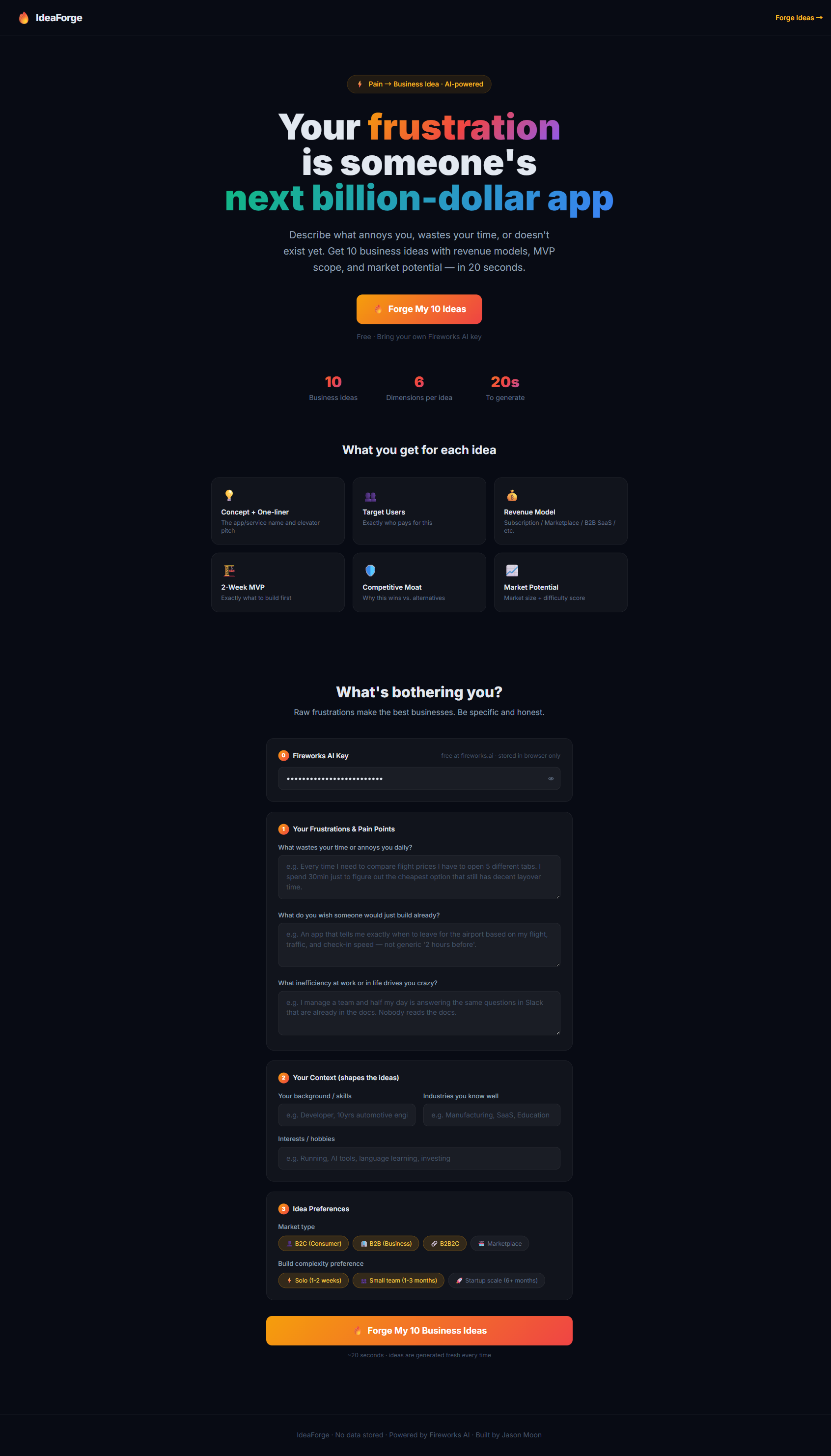
AI business idea generator that remembers your pain points and learns what kinds of ideas you like. Input your frustrations once — get 10 business ideas with revenue models, 2-week MVP scope, competitive moat, market potential, and why-now analysis. Stars the ideas you love; learns your preference patterns over time.
The Pattern
PostSpark turns your professional background into LinkedIn content. IdeaForge turns your frustrations into business ideas. Same architecture, different domain: personal context in → structured AI output out.
The original insight: raw, specific personal input generates dramatically better AI output than generic prompts. An automotive engineer gets different ideas than a nurse with the same frustrations.
But v1 had the same problem as every AI wrapper: completely stateless. Every session started from scratch. No memory of what you’d already explored. No preference signal from what resonated.
v1 → v2: The Accumulation Problem
v1 flaw: You’d describe your frustrations, get 10 ideas, find 2-3 compelling ones — and that was it. Next session, blank slate. No record of the ideas you saved. No learning about the types of ideas you preferred.
v2 thesis: The real value isn’t the generation — it’s the shortlist you build over time and the preference signal you accumulate.
What IdeaForge v2 Does
Context persistence — Your frustrations, background, and context are saved to localStorage on every generation. Return sessions load everything with one click — no re-entering three paragraphs of life context.
Idea shortlist — Every idea card has a ⭐ star button. Starred ideas are saved to ideaforge_liked across sessions. A “Your Saved Ideas” panel on the form shows your shortlist before you generate again.
Preference learning — The system tracks what kinds of ideas you star: market type (B2C/B2B/B2B2C), difficulty level (Easy/Medium/Hard), and potential rating (Medium/High/Moonshot). These patterns are injected into the next generation prompt: “User prefers: B2C market, Easy difficulty, High potential.” The AI adjusts idea distribution accordingly.
Context version history — Last 3 context snapshots saved. Click to restore any earlier version — useful when pivoting focus or revisiting a previous problem space.
Export / Import — Full JSON export includes your context, shortlist, and learned patterns. Import on any device without a backend.
Context completeness indicator — Live progress bar (0→100%) guiding users to fill all 6 fields. Underspecified context → mediocre ideas.
What Each Idea Includes
Every generated idea has 7 dimensions:
- Concept + tagline — Name and one-sentence elevator pitch
- Target users — Exactly who pays (not “businesses” — specific personas)
- Revenue model — Specific pricing mechanism with price points (not just “subscription”)
- 2-Week MVP — What a solo developer builds first to validate
- Competitive moat — Why this beats “just use Google Sheets”
- Market potential — TAM estimate + how to find first 100 customers
- Why now — The trend or technology shift that makes this viable today
Input Design
Three frustration fields (daily waste, wish existed, work inefficiency) + context fields (background, industries, interests) + preference pills (market type, build complexity). The context fields differentiate results — an automotive engineer gets different ideas than a nurse with identical frustrations.
The Preference Learning System
When a user stars an idea, the system stores: { name, tagline, marketType, difficulty, potential, likedAt }.
Before each generation, getLikedPatterns() aggregates:
- Most-starred market types → “B2C (3x), B2B (1x)”
- Most-starred difficulty level → “Easy (2x)”
- Most-starred potential level → “High (3x)”
This summary is added to the prompt as USER'S LEARNED PREFERENCES. The AI prioritizes these characteristics while maintaining variety across 10 ideas.
A competitor can copy the prompt. They cannot copy a user’s accumulated shortlist and preference signal.
Technical Design
Single HTML file, zero backend, zero server cost. Four localStorage keys:
if_key— Fireworks AI keyideaforge_profile— Context JSON (6 frustration/context fields + pill selections + savedAt)ideaforge_liked— Array of starred idea objectsideaforge_versions— Last 3 context snapshots
The full shortlist (including learned patterns) is included in the JSON export payload, making the tool’s accumulated value portable across devices without any server infrastructure.